
Where can jaw pain be caused from
February 15, 2025
Braces: Answers to the most frequently asked questions about their application
February 17, 2025Where can jaw pain be caused from
February 15, 2025Braces: Answers to the most frequently asked questions about their application
February 17, 2025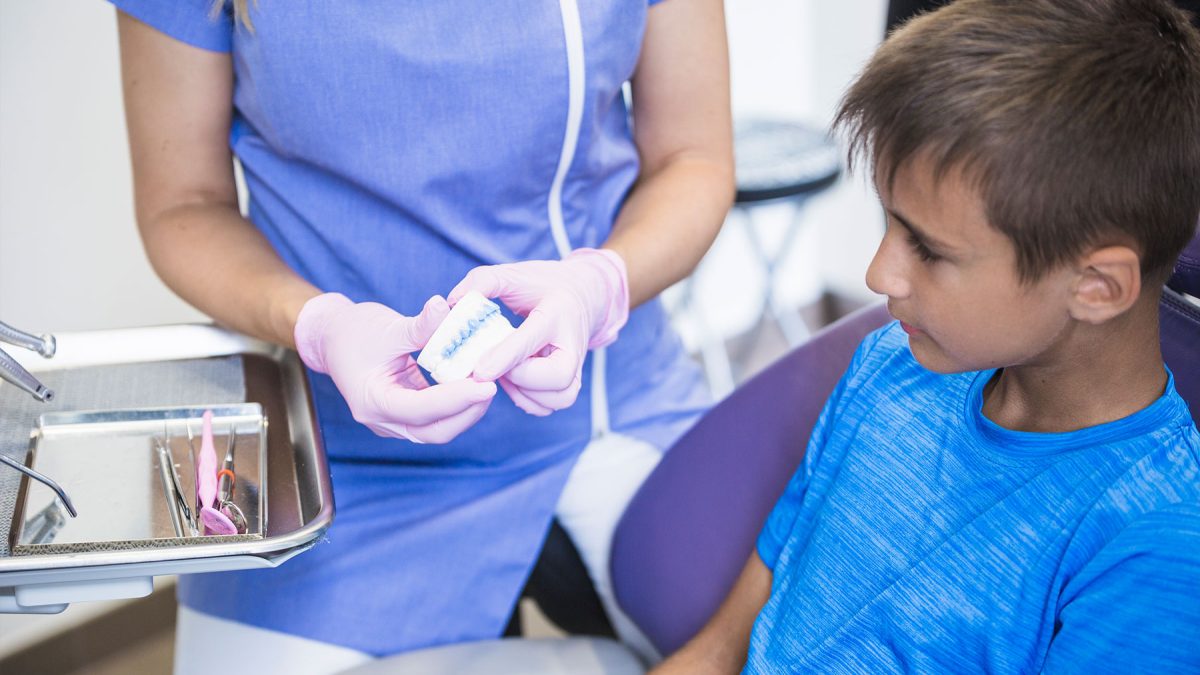
The adjustment to school life is often difficult for children and teenagers who are getting braces for the first time.
As if the changes they need to make to their daily routine are not enough, many also worry about how their classmates will react to their new appearance.
“The changes that children and teenagers need to make in their daily lives are quite a few, although their lifestyle is not dramatically affected,” says Dr. Katerina Douma-Michelaki, DDS, PhD, specialist in Orthodontics for Children & Adults. “They will still be able to participate in the same sports, play the same musical instruments, or enjoy the same activities as before. However, they may need a special protective mouthguard for sports. If they play a wind instrument, they will need a period of adjustment, but afterwards, they will be fine.”
The most important changes essentially concern their diet, she adds. “They need to avoid foods or drinks that can cause damage to the braces, as well as those that increase the risk of cavities and gingivitis,” she explains. “It is also essential that they brush their teeth properly and clean them with dental floss.”
These changes are simple, or at least seem simple, when children and teenagers are at home. However, at school, they can seem like a real mountain. To help them, Dr. Douma-Michelaki offers the following tips:
* Make sure they have a care kit with them. What is this? It is a small bag with certain products that they may need to keep their braces clean and comfortable at school.
Ideally, the kit should contain toothpaste and a toothbrush (you can find travel-sized ones at supermarkets), dental floss, and perhaps a small mirror (if there is no mirror in the school bathrooms or the child wants to check their teeth in another space).
If the child’s braces require elastics, it’s a good idea to always have a few extra elastics with them, as well as some of the special wax given by the orthodontist. This way, they can make necessary adjustments if the orthodontic wire irritates their gums at any point.
* Make sure they eat suitable food or snacks. The issue of food is more challenging for children and teenagers with braces because there are certain foods they need to avoid. However, there are many treats they can still enjoy.
The basic rule is to avoid anything that is hard, sticky, crunchy, or like gum. Practically, this means that they shouldn’t eat whole raw carrots or apples, nuts, chips, or large pieces of meat. They should also avoid hard rolls and breads (e.g., in sandwiches) and opt for softer bread. Also, foods that stick to the teeth (e.g., cookies, candies, sticky cakes) leave residue on the teeth for a long time, which increases the risk of cavities.
It is also very important to avoid carbonated drinks, sodas, isotonic drinks, and fruit juices as much as possible. Most of these drinks have a low pH, which increases the risk of cavities, according to the American Association of Orthodontists (AAO).
Good choices for breakfast include yogurt, smoothies, and eggs, while at school, a soft bread toast (without nuts) and cheese or a banana can effectively curb their hunger. If they prefer hard fruits, like apples and pears, they can cut them up at home and eat them at school by chewing them with their back teeth.
* Make sure they always have a water bottle with them. Water (still, not carbonated) is extremely important for anyone wearing braces. Not only does it rinse off food particles that might get trapped around the braces or under the orthodontic wire, but it also neutralizes the acids produced when we eat, helping keep the mouth healthier.
Although most schools have drinking fountains, it’s a good idea for the child to have their own water bottle so they can drink frequently and refill it later.
* Get a protective mouthguard for sports. If the child participates in a sport that poses a high risk of injury to the mouth, it’s a good idea for them to use a protective mouthguard.
Such sports include, among others, basketball, cycling, boxing, horseback riding, football, handball, skating, martial arts, racquet sports, volleyball, water polo, etc.
If the child already had a protective mouthguard, they may need to get a new one that is properly adjusted for their braces.
* Help them understand they are not alone. A few decades ago, very few children and teenagers wore braces, but today, even adults wear them. Children need to know that they are not alone and there is no reason to be ashamed to smile or laugh. Nor should they isolate themselves.
Encourage them to go out and have fun with their friends, keeping in mind that soon they will take off their braces and have a healthy smile for life.
Additionally, new technologies with digitized clear aligners used in teenagers and children now provide the opportunity for treatments with high aesthetics without braces.
However, the most important criterion is proper treatment, based on medical values and correct cooperation from all for an excellent and timeless smile!

